# OpenACP
**Self-hosted bridge between messaging platforms and AI coding agents**
One message, any channel, any agent.
[](LICENSE)
[](https://nodejs.org/)
[](https://agentclientprotocol.org/)
[](https://www.npmjs.com/package/@openacp/cli)
[](https://x.com/Open_ACP)
[Getting Started](docs/guide/getting-started.md) | [Agents](docs/guide/agents.md) | [Usage](docs/guide/usage.md) | [Configuration](docs/guide/configuration.md) | [Plugins](docs/guide/plugins.md) | [Development](docs/guide/development.md)
---
## What is OpenACP?
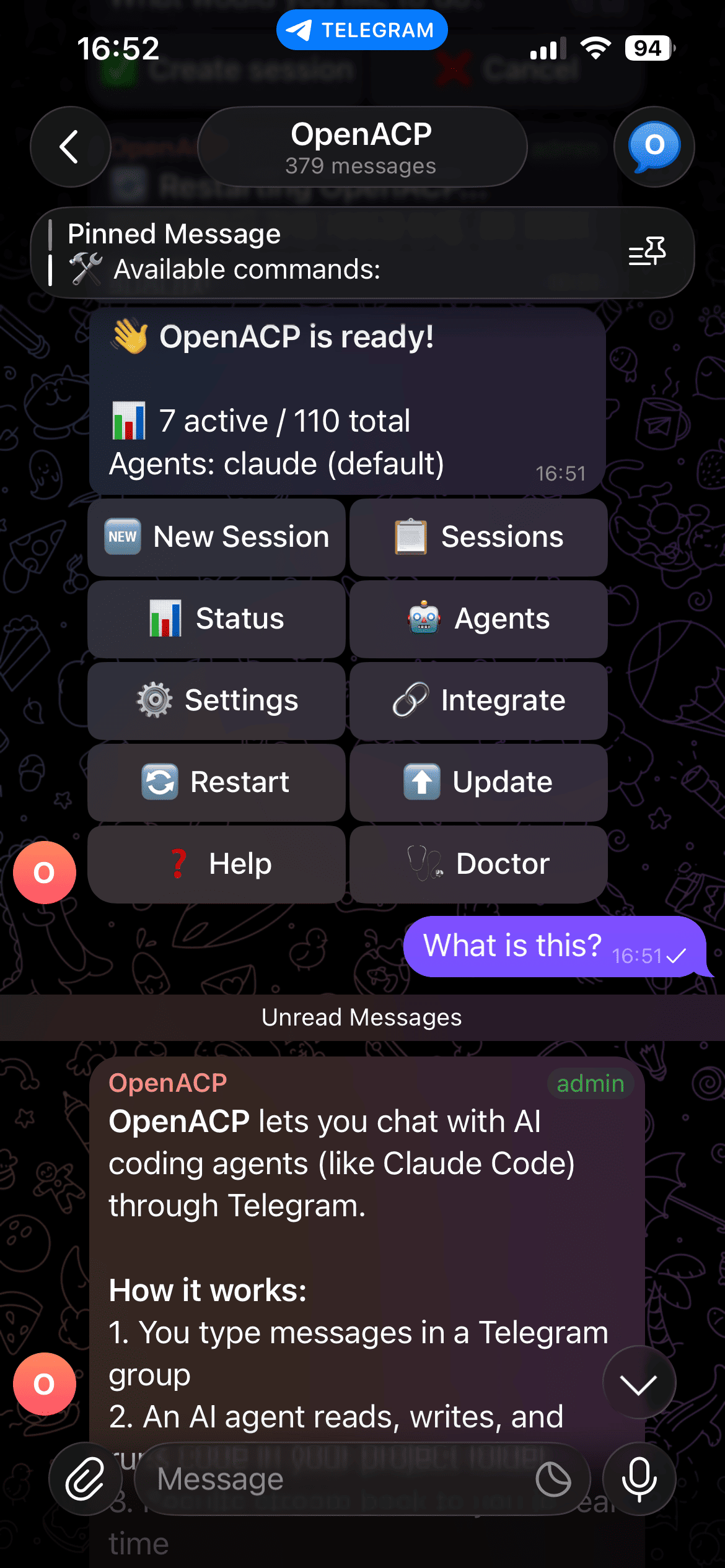
OpenACP lets you control AI coding agents (Claude Code, Codex, ...) from messaging apps like Telegram and Discord. You send a message, the agent writes code, runs commands, and streams everything back — in real time.
It uses the [Agent Client Protocol (ACP)](https://agentclientprotocol.org/) to talk to agents. You host it on your own machine, so you own the data.
```
You (Telegram / Discord / ...)
↓
OpenACP ─── ChannelAdapter ─── Session Manager ─── Session Store
↓ ↓
ACP Protocol (JSON-RPC / stdio) Tunnel Service
↓ ↓
AI Agent (Claude Code, Codex, ...) File/Diff Viewer
```
## Screenshots
Control Panel Manage sessions, agents, and settings
Agent at Work Plans, reads files, writes code
Real-time Tool Calls See every action the agent takes
Agent Skills Brainstorming, TDD, debugging & more
## Supported Agents
OpenACP follows the [Agent Client Protocol (ACP)](https://agentclientprotocol.com/) standard — an open protocol for connecting AI coding agents to client applications. Agent definitions are loaded from the [official ACP Registry](https://agentclientprotocol.com/get-started/registry) via CDN ([`registry.json`](https://cdn.agentclientprotocol.com/registry/v1/latest/registry.json)), so new agents are available as soon as they're registered.
| Agent | Distribution | Description |
|-------|-------------|-------------|
| [Claude Agent](https://github.com/anthropics/claude-code) | npx | Anthropic's Claude coding agent |
| [Gemini CLI](https://github.com/google-gemini/gemini-cli) | npx | Google's official CLI for Gemini |
| [Codex CLI](https://github.com/openai/codex) | npx | OpenAI's coding assistant |
| [GitHub Copilot](https://github.com/github/copilot-cli) | npx | GitHub's AI pair programmer |
| [Cursor](https://www.cursor.com/) | binary | Cursor's coding agent |
| [Cline](https://github.com/cline/cline) | npx | Autonomous coding agent with file editing, commands, and browser |
| [goose](https://github.com/block/goose) | binary | Open source AI agent for engineering tasks |
| [Amp](https://github.com/tao12345666333/amp-acp) | binary | The frontier coding agent |
| [Auggie CLI](https://www.augmentcode.com/) | npx | Augment Code's agent with industry-leading context engine |
| [Junie](https://www.jetbrains.com/) | binary | AI coding agent by JetBrains |
| [Kilo](https://github.com/kilocode/kilo) | npx | The open source coding agent |
| [Qwen Code](https://github.com/QwenLM/qwen-code) | npx | Alibaba's Qwen coding assistant |
| [crow-cli](https://github.com/crowdecode/crow-cli) | uvx | Minimal ACP native coding agent |
| ...and more | | [See full registry →](https://agentclientprotocol.com/get-started/registry) |
> **28+ agents supported** — any agent registered in the ACP Registry works out of the box. Install with `openacp agents install ` or browse from Telegram with `/agents`.
## Features
- **Multi-agent** — Claude Code, Codex, Gemini, Cursor, and [28+ ACP-compatible agents](#supported-agents)
- **Telegram** — Forum topics, real-time streaming, permission buttons, skill commands
- **Discord** — Forum/thread-based sessions, slash commands, button interactions
- **Session persistence** — Resume sessions across restarts
- **Daemon mode** — Background service with auto-start on boot
- **CLI API** — Create and manage sessions from the terminal
- **Config editor** — Interactive `openacp config` for all settings
- **Setup wizard** — Interactive first-run setup with bot validation and auto-detect
- **Plugin system** — Install channel adapters as npm packages
- **Structured logging** — Pino with rotation, per-session log files
- **Self-hosted** — Your keys, your data, your machine
### [Tunnel & Port Forwarding](docs/guide/tunnel.md)
Expose any local port to the internet — dev servers, APIs, static sites. Tunnel is enabled by default with Cloudflare (free, no account needed).
- `/tunnel 3000 my-app` in Telegram or `openacp tunnel add 3000 --label my-app` from CLI
- `/tunnels` to list active tunnels with public URLs and stop buttons
- Agents can create tunnels too — say "expose port 5173" and the agent handles it
- Built-in file/diff viewer — Monaco Editor (VS Code engine) with syntax highlighting, line range links, markdown preview
- Providers: Cloudflare (default), ngrok, bore, Tailscale Funnel
## Setup
### Prerequisites
- **Node.js 20+**
- **A messaging platform** — Telegram, Discord, or both:
- **Telegram**: Create a bot via [@BotFather](https://t.me/BotFather), create a supergroup with Topics enabled, add bot as admin
- **Discord**: Create a bot at [Discord Developer Portal](https://discord.com/developers/applications), invite it to your server with Manage Channels + Send Messages permissions
### Install & first run
```bash
npm install -g @openacp/cli
openacp
```
> **Important: `openacp` is an interactive CLI.**
> The first run launches a setup wizard that asks you questions in the terminal (bot token, server selection, workspace path, etc.).
> You **must run it yourself in a terminal** — it cannot be run by a script or an AI agent because it requires interactive input.
The wizard will:
1. **Choose your channel(s)** — Telegram, Discord, or both
2. **Configure bot credentials** — bot token and server/group ID, validated against the platform API
3. **Set a workspace directory** — where agents will create project folders (default: `~/openacp-workspace`)
4. **Detect installed agents** — finds Claude Code, Codex, etc.
5. **Choose run mode** — foreground (in terminal) or background (daemon with auto-start)
Config is saved to `~/.openacp/config.json`. After setup, OpenACP starts automatically.
### Running after setup
```bash
# Foreground (shows logs in terminal)
openacp
# Or as a background daemon
openacp start
openacp stop
openacp status
openacp logs
```
### Other CLI commands
```bash
# Agent management
openacp agents # List all agents (installed + available)
openacp agents install # Install an agent from the ACP Registry
openacp agents uninstall # Remove an installed agent
openacp agents info # Show agent details & dependencies
openacp agents refresh # Force-refresh the registry
# API (requires running daemon)
openacp api new [agent] [workspace] # Create a new session
openacp api cancel # Cancel a session
openacp api status # Show active sessions
openacp api agents # List available agents
# System
openacp config # Interactive config editor
openacp reset # Re-run the setup wizard
openacp update # Update to latest version
openacp install # Install a plugin (e.g. @openacp/adapter-discord)
openacp uninstall
openacp plugins # List installed plugins
```
## Usage
Once OpenACP is running, control it from Telegram or Discord:
**Telegram** — Bot commands in your supergroup:
| Command | Description |
|---------|-------------|
| `/new [agent] [workspace]` | Create a new session |
| `/newchat` | New session, same agent & workspace |
| `/cancel` | Cancel current session |
| `/status` | Show session or system status |
| `/agents` | Browse & install agents from ACP Registry |
| `/install ` | Install an agent directly |
Each session gets its own forum topic.
**Discord** — Slash commands in your server:
| Command | Description |
|---------|-------------|
| `/new [agent] [workspace]` | Create a new session |
| `/newchat` | New session, same agent & workspace |
| `/cancel` | Cancel current session |
| `/status` | Show session or system status |
| `/menu` | Open the control panel |
Each session gets its own thread in the sessions channel. The agent streams responses in real time, shows tool calls, and asks for permission when needed.
### Session Transfer
Move sessions between your terminal and messaging platforms:
**Terminal → Chat:**
```bash
# Install integration (one-time)
openacp integrate claude
# In Claude CLI, type /openacp:handoff to transfer the current session
# Or manually:
openacp adopt claude --cwd /path/to/project
```
**Chat → Terminal:**
Type `/handoff` in any session topic/thread. The bot replies with a command you can paste in your terminal to continue.
Sessions are not locked after transfer — you can continue from either side.
## Roadmap
- **Phase 1** — Core + Telegram + ACP agents
- **Phase 2** — Tunnel/file viewer, session persistence, logging, plugin system
- **Phase 3** — Agent skills as commands, Discord adapter 🚧, Web UI
- **Phase 4** — Voice control, file/image sharing
- **Phase 5** — WhatsApp, agent chaining, plugin marketplace
## Star History
## Contributing
See [development guide](docs/guide/development.md).
## Follow Us
[](https://x.com/Open_ACP)
## License
[MIT](LICENSE)