 ae6a562d5d
## Summary
Standardizes the operation names used throughout the spec and Python
tutorials so they match the canonical A2A operation names (`Send
Message` / `Send Streaming Message`) instead of the older JSON-RPC-style
identifiers (`message/send`, `message/stream`) or the inconsistent short
form `Stream Message`.
## Changes
- **`docs/specification.md`**
  - Architecture diagram: `Stream Message` → `Send Streaming Message`.
  - Section 3.1.3 (Get Task): `message/send` → `Send Message`.
  - Event delivery section: `Stream Message` → `Send Streaming Message`.
- Multi-protocol functionality table: `Stream message` → `Send Streaming
Message`.
- **`docs/tutorials/python/4-agent-executor.md`**: `message/send` /
`message/stream` → `Send Message` / `Send Streaming Message`.
- **`docs/tutorials/python/6-interact-with-server.md`**: same rename in
the `test_client.py` description.
- **`docs/tutorials/python/7-streaming-and-multiturn.md`**:
`message/send` → `Send Message` in the `CurrencyAgentExecutor`
walkthrough.
## Why
The docs previously mixed three different names for the same operations
(`message/stream`, `Stream Message`, `SendStreamingMessage`), which was
confusing for readers cross-referencing the spec, tutorials, and SDK.
This change picks one human-readable form per operation and uses it
consistently in prose, while leaving the code-level identifiers
(`SendMessage`, `SendStreamingMessage`, `POST /message:stream`, etc.)
untouched in the protocol-binding tables.
Agent2Agent (A2A) Protocol


Agent2Agent (A2A) Protocol
An open protocol enabling communication and interoperability between opaque agentic applications.
The Agent2Agent (A2A) protocol addresses a critical challenge in the AI landscape: enabling gen AI agents, built on diverse frameworks by different companies running on separate servers, to communicate and collaborate effectively - as agents, not just as tools. A2A aims to provide a common language for agents, fostering a more interconnected, powerful, and innovative AI ecosystem.
With A2A, agents can:
- Discover each other's capabilities.
- Negotiate interaction modalities (text, forms, media).
- Securely collaborate on long-running tasks.
- Operate without exposing their internal state, memory, or tools.
DeepLearning.AI Course
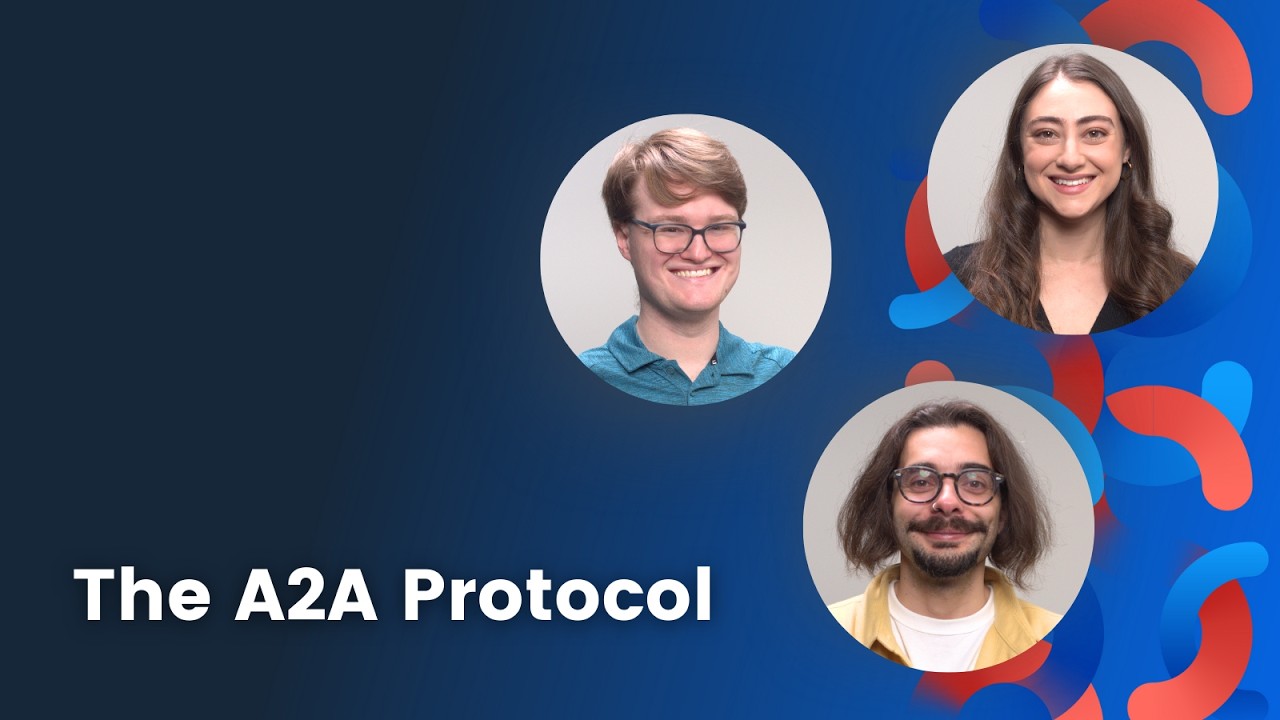
Join this short course on A2A: The Agent2Agent Protocol, built in partnership with Google Cloud and IBM Research, and taught by Holt Skinner, Ivan Nardini, and Sandi Besen.
What you'll learn:
- Make agents A2A-compliant: Expose agents built with frameworks like Google ADK, LangGraph, or BeeAI as A2A servers.
- Connect agents: Create A2A clients from scratch or using integrations to connect to A2A-compliant agents.
- Orchestrate workflows: Build sequential and hierarchical workflows of A2A-compliant agents.
- Multi-agent systems: Build a healthcare multi-agent system using different frameworks and see how A2A enables collaboration.
- A2A and MCP: Learn how A2A complements MCP by enabling agents to collaborate with each other.
Why A2A?
As AI agents become more prevalent, their ability to interoperate is crucial for building complex, multi-functional applications. A2A aims to:
- Break Down Silos: Connect agents across different ecosystems.
- Enable Complex Collaboration: Allow specialized agents to work together on tasks that a single agent cannot handle alone.
- Promote Open Standards: Foster a community-driven approach to agent communication, encouraging innovation and broad adoption.
- Preserve Opacity: Allow agents to collaborate without needing to share internal memory, proprietary logic, or specific tool implementations, enhancing security and protecting intellectual property.
Key Features
- Standardized Communication: JSON-RPC 2.0 over HTTP(S).
- Agent Discovery: Via "Agent Cards" detailing capabilities and connection info.
- Flexible Interaction: Supports synchronous request/response, streaming (SSE), and asynchronous push notifications.
- Rich Data Exchange: Handles text, files, and structured JSON data.
- Enterprise-Ready: Designed with security, authentication, and observability in mind.
Getting Started
- 📚 Explore the Documentation: Visit the Agent2Agent Protocol Documentation Site for a complete overview, the full protocol specification, tutorials, and guides.
- 📝 View the Specification: A2A Protocol Specification
- Use the SDKs:
- 🐍 A2A Python SDK
pip install a2a-sdk - 🐿️ A2A Go SDK
go get github.com/a2aproject/a2a-go - 🧑💻 A2A JS SDK
npm install @a2a-js/sdk - ☕️ A2A Java SDK using maven
- 🔷 A2A .NET SDK using NuGet
dotnet add package A2A
- 🐍 A2A Python SDK
- 🎬 Use our samples to see A2A in action
Contributing
We welcome community contributions to enhance and evolve the A2A protocol!
- Questions & Discussions: Join our GitHub Discussions.
- Issues & Feedback: Report issues or suggest improvements via GitHub Issues.
- Contribution Guide: See our CONTRIBUTING.md for details on how to contribute.
- Private Feedback: Use this Google Form.
- Partner Program: Google Cloud customers can join our partner program via this form.
What's next
Protocol Enhancements
- Agent Discovery:
- Formalize inclusion of authorization schemes and optional credentials directly within the
AgentCard.
- Formalize inclusion of authorization schemes and optional credentials directly within the
- Agent Collaboration:
- Investigate a
QuerySkill()method for dynamically checking unsupported or unanticipated skills.
- Investigate a
- Task Lifecycle & UX:
- Support for dynamic UX negotiation within a task (e.g., agent adding audio/video mid-conversation).
- Client Methods & Transport:
- Explore extending support to client-initiated methods (beyond task management).
- Improvements to streaming reliability and push notification mechanisms.
About
The A2A Protocol is an open source project under the Linux Foundation, contributed by Google. It is licensed under the Apache License 2.0 and is open to contributions from the community.